We are building products in the most technologically advanced era in history. AI can summarize data in seconds, analytics dashboards give us real-time metrics, IoT devices generate continuous streams of behavioral information. Yet, many products are still failing. Why? Because we are shipping products based on assumptions.
The Comfort of Secondary Research
Today, most product research depends heavily on:
- Market reports
- Analytics dashboards
- Competitor analysis
- AI-generated insights
- Industry trend reports
These are powerful tools. I use them too but here’s the problem: Secondary data tells you what happened, it rarely tells you why it happened. And “why” is where real product clarity lives.
AI Is Fast But It Doesn’t Talk to Your Users
AI is an incredible tool. It makes our work faster, smarter, and more efficient. But let’s be honest: AI only works with the data it has been trained on. It analyzes existing information, predicts patterns, and identifies trends. But it does not:
- Sit across from your user.
- Hear hesitation in their voice.
- Notice frustration in their facial expression.
- Detect emotional pain points hidden behind short answers.
AI processes data, UX Designers interpret humans. And those are two very different things.
IoT and Real-Time Data: Still Not Enough
The emergence of IoT gives us real-time behavioral data. We can track:
- Device usage
- Interaction frequency
- Drop-off points
- Environmental triggers
But raw data is not insight. Data needs:
- Context
- Interpretation
- Human understanding
Without speaking to users, you may know that 60% drop off at step 3, but you won’t know why they feel stuck there.
A Personal Experience: Recruitment vs User Research
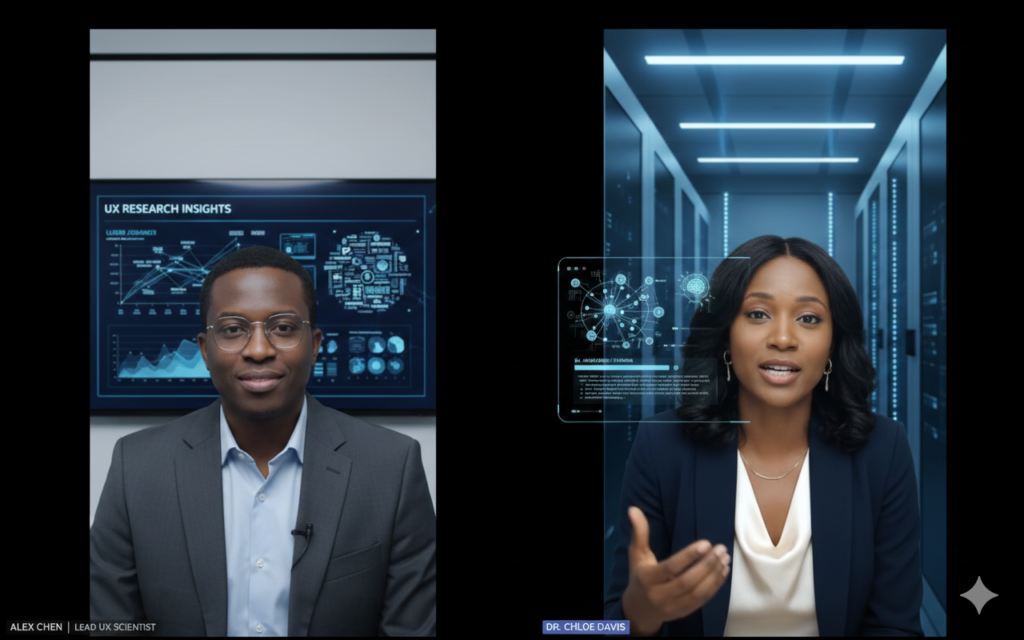
Recently, I had the privilege of conducting a recruitment interview for a startup. And something clicked for me. The process felt natural. Because as a UX Designer, conducting interviews is second nature. The only difference?
- In recruitment interviews, you gather insights to onboard the right candidate.
- In user research interviews, you gather insights to design the right solution.
But the core similarities are powerful:
Similarities Between Recruitment Interviews & User Research Interviews
- You ask open-ended questions.
- You listen more than you talk.
- You observe non-verbal cues.
- You probe deeper with follow-up questions.
- You seek clarity, not assumptions.
- You validate claims with examples.
- You look for patterns across multiple interviews.
In both cases, you are trying to understand:
- Motivations
- Pain points
- Goals
- Behaviors
- Decision-making processes
The goal is alignment: In recruitment it is role-candidate alignment, in UX research it is problem-solution alignment. They both require empathy, active listening, removing bias.
Assumptions Are Expensive
When we don’t talk to users, we start filling the gaps ourselves: “I think users prefer this”, “They probably want this feature”, “Other competitors are doing it”, “Analytics shows this button is used frequently”.
Assumptions feel efficient but are expensive. They cost:
- Development time
- Design iterations
- Rework
- User trust
Nothing is more powerful than hearing a user say: “Honestly, that’s not what I need”. That single sentence can save months of wrong execution.
User Interviews Are Evergreen
There is this quiet belief growing in tech: “AI will replace user research”. It won’t, in fact, AI depends on primary data to stay relevant. Without fresh human input, even AI becomes outdated. User interviews are not old school, they are foundational. They:
- Reduce risk
- Increase clarity
- Improve product-market fit
- Strengthen empathy
- Drive smarter innovation
And most importantly, they ensure we are designing for real people.
The Future Is Not AI vs Research, It’s AI Plus Research
Use AI for:
- Speed
- Data analysis
- Pattern recognition
- Documentation
But use interviews for:
- Understanding emotions
- Discovering unmet needs
- Uncovering hidden frustrations
- Validating assumptions
Technology accelerates us, humans guide us.
Let’s Stop Designing in Isolation
If you’re building a product today and relying only on: Google searches, ChatGPT outputs, trend reports, analytics dashboards. Pause and talk to your users, ask them uncomfortable questions, let them challenge your assumptions, that is where innovation truly begins.
Need Help Conducting User Research?
If you’re building a product and:
- Unsure what questions to ask
- Struggling to structure interviews
- Not getting actionable insights
- Designing based on assumptions
I can help, user research should not feel overwhelming, it should feel empowering. Reach out if you need help conducting meaningful user interviews that translate into real design decisions.
Because designing without talking to users? that’s the real outdated practice.